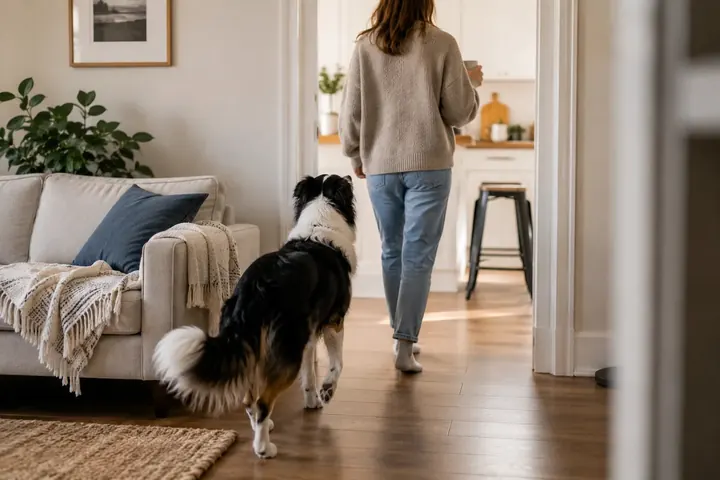
Why do dogs like to sleep near you?
At the foot of the bed or against your legs: what explains this habit.
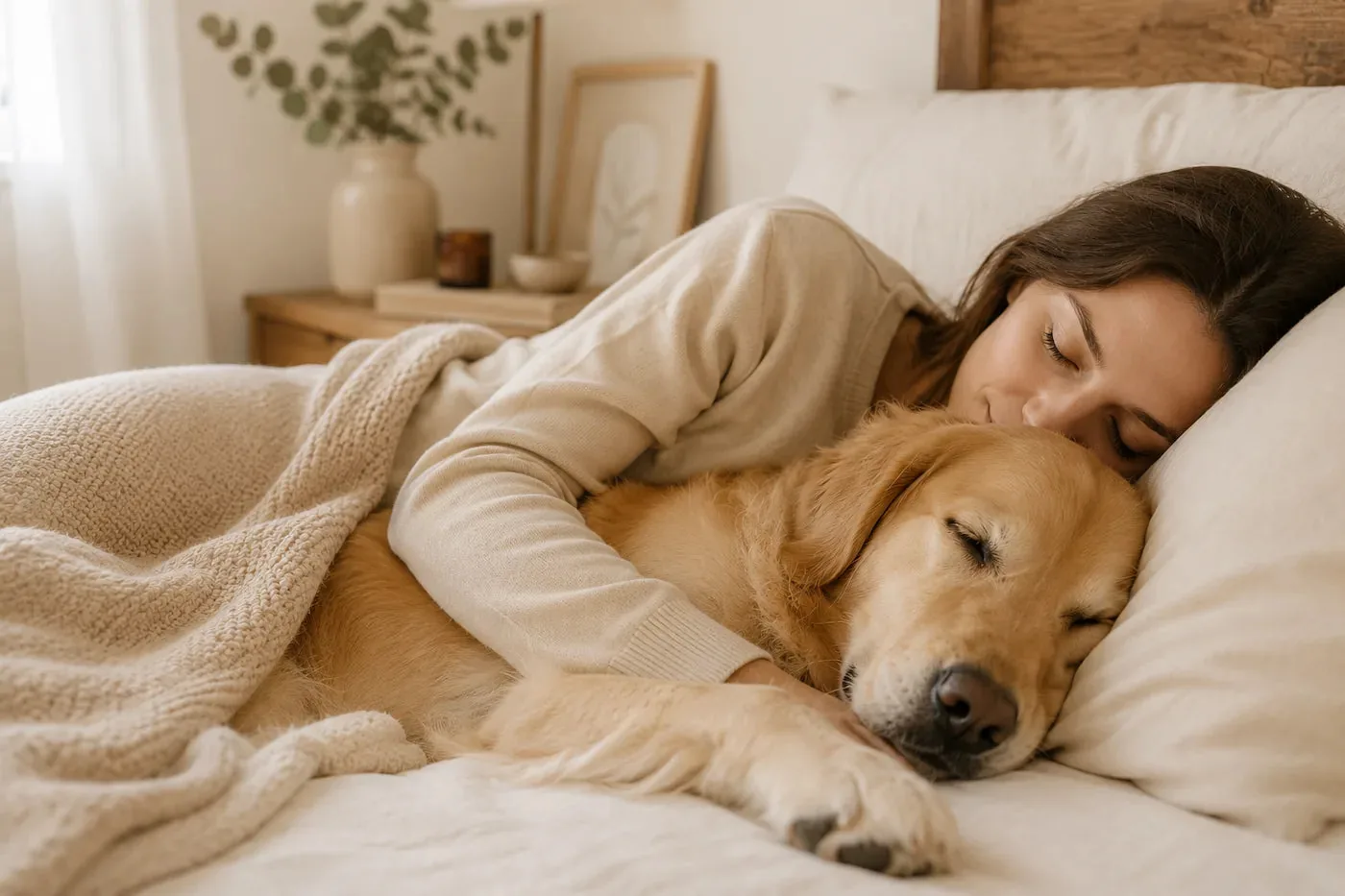
🐾 At bedtime, your dog may have a little habit all its own.
It waits for you to settle in before going to its basket. It stretches out at the foot of the bed as soon as the lights go off. Or it always picks the same corner of the couch when you watch a movie.
Wherever it is, one thing often comes up: it likes to stay close to you when it rests.
This behaviour raises plenty of questions. Is it a sign of affection? A habit learned over the years? A way to feel protected?
The answer is more nuanced than it seems.
Behind this habit lie instincts inherited from its ancestors, personal preferences and the special bond it has developed with its people.
Dogs are naturally social animals
Long before sharing our homes, dogs' ancestors lived in groups.
This arrangement had several advantages. Staying together helped conserve heat, detect danger more easily and improve the chances of survival.
Rest time was no exception.
Sleeping near other group members helped create a more reassuring environment. Everyone benefited from the others' presence.
Even though your companion now enjoys a comfortable home, this behavioural heritage is still very much present.
When it chooses to settle near you, it's partly reproducing a reflex deeply rooted in its history.
Sleeping near you is often a sign of trust
Sleep is a special moment.
When a dog closes its eyes and fully relaxes, it becomes more vulnerable to what's around it.
Imagine having to spend the night somewhere unfamiliar. Most people would instinctively look for a place where they feel at ease.
For a dog, the principle is similar.
By choosing to rest near you, it generally shows that it feels good in this environment. Your presence becomes a familiar landmark that lets it lower its guard.
This doesn't necessarily mean it can't be alone or has a behaviour problem. In most situations, it's simply a relationship based on trust.
Your scent is one of its landmarks
Dogs discover the world mainly through their sense of smell.
While we rely mostly on sight, they gather an impressive amount of information through the smells around them.
Your clothes, your blanket, your favourite armchair and even your bed carry your scent signature.
For your dog, these smells are linked to its environment, its routines and the pleasant moments spent with the people who share its daily life.
That's also why some dogs like to settle on a piece of clothing left on the floor or on a blanket that belongs to you.
It's not necessarily the fabric that attracts them, but what it represents.
Comfort and warmth matter too
Sometimes the explanation is much simpler.
You're comfortable.
Dogs appreciate cozy spots. A soft blanket, a basket, a cushion or a well-suited dog bed are often very appealing places to rest.
Your body also gives off warmth, which can be especially appreciated during cooler periods.
You may have noticed that your dog doesn't always choose the most luxurious cushion in the house.
Despite an excellent bed in the living room, it sometimes prefers to stretch out right next to your chair or near the bed.
For many dogs, being close to their people sometimes matters as much as the place itself.
🧡 In short
The main reasons for this behaviour:
✔ They feel safe.
✔ They like being close to you.
✔ They appreciate comfortable spots.
✔ Your scent is familiar to them.
✔ Their social instinct naturally leads them to stay near their group.
Why do some dogs like to snuggle while others keep their distance?
Not all dogs show attachment the same way.
Some love physical contact. They constantly try to snuggle against a leg, a foot or a shoulder.
Others prefer to keep a little space while staying in the same room.
These differences can be explained by the following factors:
Personality
Like humans, every dog has its own temperament.
Some seek more interaction, while others enjoy their independence.
Age
Puppies often seek their people's presence more.
Older dogs may also appreciate a familiar environment as they become less comfortable with change.
Past experiences
A move, a recent adoption or a major change in routine can influence a dog's preferences about where it rests.
💡 Did you know?
Dogs generally spend between 50% and 60% of their day sleeping or resting.
So the spot they choose matters. A place where they feel good contributes directly to their quality of life.

Can where your dog sleeps reveal something?
Every animal is unique, but some choices are seen more often.
At the foot of the bed
This position lets it stay close to its people while keeping its own space.
Against your legs
This light contact lets it feel your movements while enjoying a pleasant source of warmth.
Against your back
Some dogs especially enjoy this position, which combines closeness and a sense of stability.
Between two people
When it shares its space with two humans, it may choose to settle in the middle of the group.
In its own basket, but in the same room
This behaviour is very common. It enjoys your presence without necessarily seeking direct contact.
In another room
This choice doesn't necessarily mean emotional distance.
Some dogs prefer a quieter, cooler spot or one better suited to their habits.
Do dogs dream when they sleep near us?
You may have seen paws twitching, ears flicking or little whimpers during sleep.
Like humans, dogs go through different stages of sleep, some of which are associated with dreaming.
Although it's impossible to know exactly what they dream about, they probably relive some experiences from their day, like a walk, a play session or meeting another dog.
So the next time you see your companion moving slightly while it sleeps, it may simply be dreaming.
Why does your dog suddenly want to sleep near you?
A change in habits sometimes deserves a closer look.
If your dog usually chose its own resting place and suddenly starts seeking your presence more, different explanations are possible.
For example:
- aging;
- a move;
- a new pet;
- a change in the household routine;
- a more stressful period;
- physical discomfort.
With age, some dogs become more sensitive to change and appreciate familiar environments more.
In other situations, they may simply be looking for a little more comfort during a period of transition.
If this change appears suddenly and comes with other unusual behaviours, a veterinary visit is a good idea to rule out a medical cause.
Is it a bad habit to let your dog sleep in your bedroom?
There's no universal answer.
For some households, sharing the same space at night helps create a pleasant, reassuring routine.
Elsewhere, it can disrupt sleep or cause some inconveniences related to allergies, nighttime movement or lack of space.
What matters most is finding a solution that works for everyone in the home.
A dog doesn't need to sleep in your bed to be happy.
What matters more is that it has a comfortable place where it can fully relax.
When should you look into it further?
Sleeping near you is generally normal behaviour.
However, it can be useful to watch the situation more closely if your dog:
- seems unable to stay alone;
- shows significant distress when you leave;
- destroys things while you're away;
- vocalizes excessively when it can't see you;
- seems constantly worried when it loses track of you.
On its own, sleeping near you is generally not a concern.
It's the overall set of behaviours that helps determine whether professional support could be helpful.
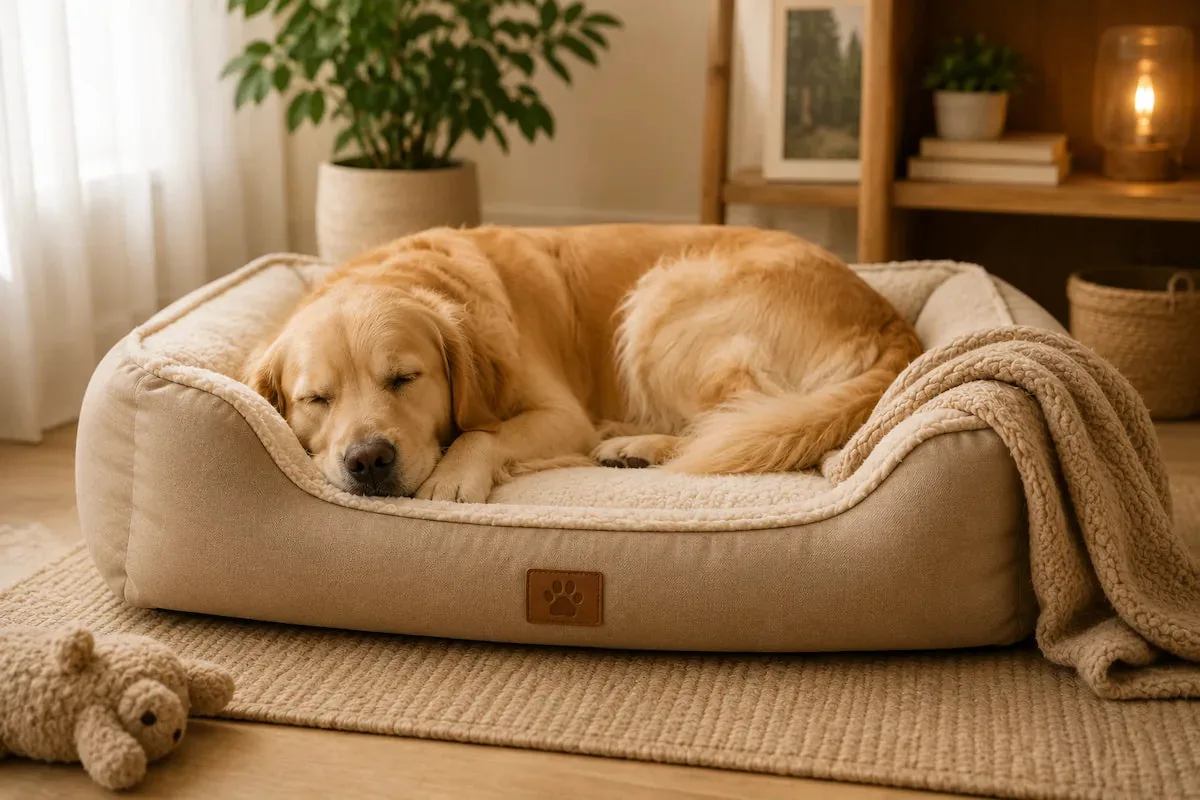
How can you give your dog a comfortable place to rest?
Dogs spend a large part of their day sleeping or recovering.
Giving them a place suited to their needs contributes directly to their well-being.
A good resting spot should ideally include:
- a surface suited to its size;
- a quiet location;
- a pleasant temperature;
- good joint support;
- an environment where it feels safe.
Depending on its age and physical condition, an orthopedic bed, a supportive mattress or a washable basket can be excellent options.
If your companion constantly tries to settle on your bed or couch, adding a comfortable spot in a room the household uses often can sometimes make all the difference.
🐾 A little boost for its comfort
If your dog loves spending long hours resting near you, an orthopedic mattress or a dog blanket can help it make the most of its downtime.
The goal isn't to keep it away from its people, but to give it a pleasant place it will want to use.
And your dog, where does it prefer to sleep?
- At the foot of the bed
- In its own basket
- Against your legs
- On the couch
- In another room
Every dog has its preferences.
Watching its habits often teaches you more about its personality and what reassures it most.
Conclusion
If your dog likes to sleep near you, it's probably looking for much more than a comfortable spot.
Your presence is a familiar landmark in its environment. It's linked to its routines, the moments you share and the sense of well-being it feels around the people who matter to it.
Between its social instincts, its need for landmarks, its love of comfort and its bond with you, there are many reasons that can explain this behaviour.
Whether it chooses the foot of the bed, a basket a few steps away or a corner of the couch on a quiet evening, this habit often reflects the trust it places in you.
The next time you see it settle in for the night, take a few seconds to notice the spot it chooses.
You may discover a new side of its personality… or a lovely sign of the bond you share. 🐾
Read next
- The most common dog behaviours and how to respond effectively
- Why do dogs love treats so much?
- Signs of boredom in dogs: how to recognize them?
This article draws in particular on information published by the American Kennel Club (AKC), VCA Animal Hospitals, PetMD and Blue Cross on dogs' sleeping habits, canine social behaviour, the bond between dogs and their people, and the factors that can influence their resting preferences.
These veterinary and animal behaviour organizations highlight the importance of a sense of security, familiar landmarks, daily routines, comfort and environment in how dogs choose where to rest.